
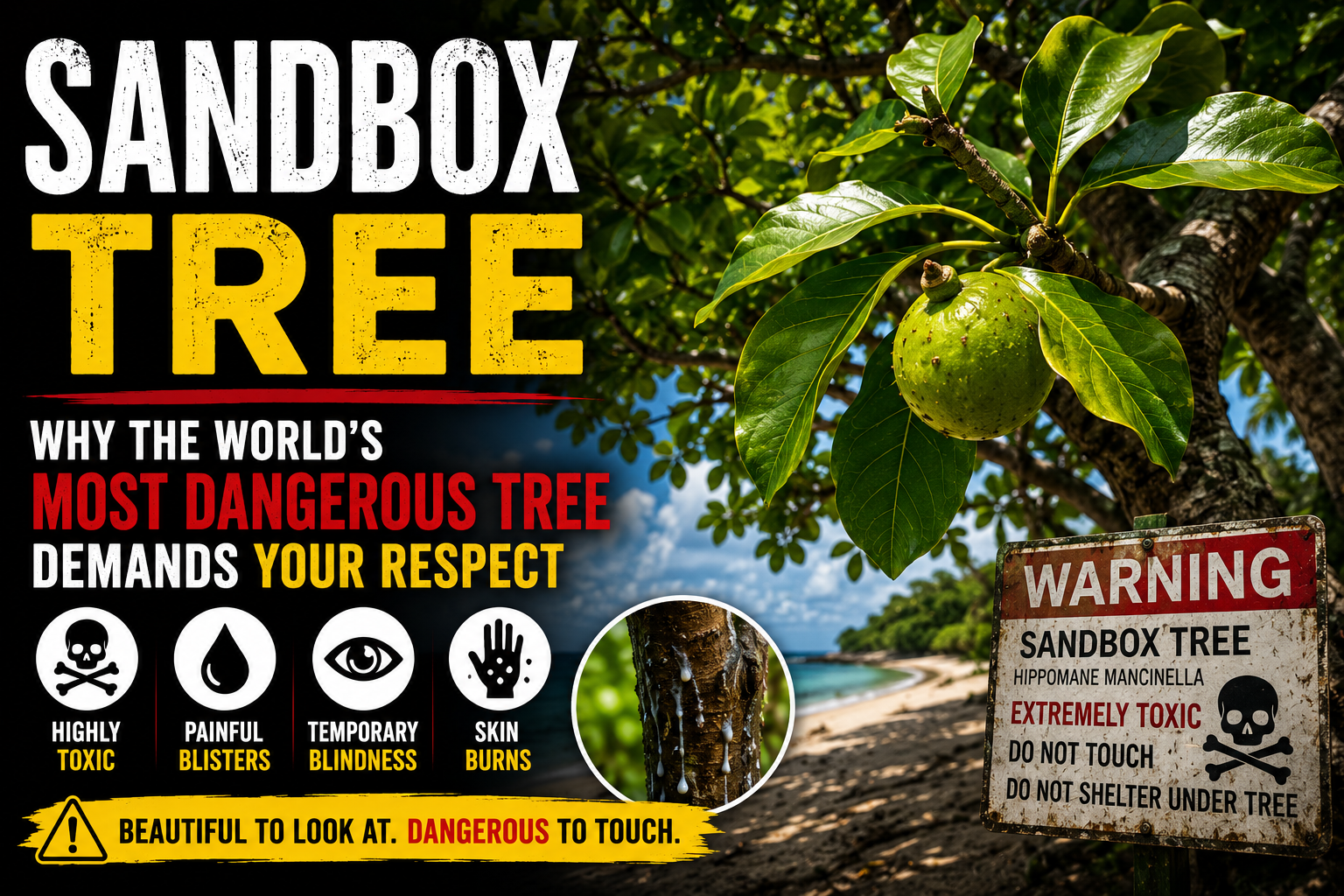
The sandbox tree (Hura crepitans) is often labeled the most dangerous tree on Earth, and this reputation is well-earned. Every part of this tropical giant, from its poison-laden sap to its ballistic seed pods, has evolved formidable defense mechanisms that can cause serious harm. Understanding this tree is not about cultivating fear; it is about equipping yourself with the knowledge to admire it safely, manage it responsibly, and appreciate its complex role within its native ecosystem. Whether you encounter it in a tropical forest or are simply fascinated by botanical extremes, the sandbox tree demands a closer, more cautious look.
What Exactly Is a Sandbox Tree?
Native to the tropical regions of North and South America, the sandbox tree is a member of the Euphorbiaceae (spurge) family. It thrives in lowland, humid forests but has been introduced to other tropical areas, sometimes becoming invasive. Reaching heights of up to 60 meters (200 feet), it is an imposing figure. However, its most memorable features are its physical defenses and its unique method of propagation, both of which contribute to its formidable legacy.
A Living Fortress: The Danger of Spines and Sap
The sandbox tree’s trunk and branches are densely covered in sharp, conical spines. In the wild, these spines discourage large animals from climbing or rubbing against the bark, protecting the tree’s vital systems. When the tree is young, the spines are even more pronounced.
Even more dangerous is its latex-like sap, which is highly toxic. Containing compounds such as huratoxin, a mere drop in the eye can cause severe inflammation and temporary blindness. Contact with skin results in painful blistering and chemical burns, while ingestion constitutes a medical emergency. The sap was historically used by indigenous peoples to poison arrow tips for hunting, a practice that underscores its deadly potency.
The “Monkey No-Climb” and “Dynamite Tree”
Two common nicknames perfectly encapsulate the sandbox tree’s character. “Monkey-no-climb” is a literal warning referencing the armored bark that makes ascent nearly impossible. “Dynamite tree,” its most vivid alias, refers to its explosive seed dispersal. When mature, the pumpkin-shaped seed capsules dry and detonate with a sharp crack, launching 12 to 16 hard, flattened seeds at velocities exceeding 70 meters per second (150 mph). The sound is comparable to a gunshot, and the projectiles are capable of causing significant injury or breaking windows from a considerable distance.
The Sandbox Tree in Its Ecosystem
Despite the hazards it presents to humans, the sandbox tree is an integrated part of its native habitat. Its dangers are matched by surprising ecological contributions.
A Pollinator’s Paradox
The sandbox tree’s male flowers are a deep, velvety red and lack petals, but they are rich in nectar and pollen. They are primarily pollinated by bats and certain insects. This relationship is a beautiful paradox: a plant weaponized with spines and toxins provides a vital food source for nocturnal pollinators that navigate through the dense forest. The tree offers sustenance, and in return, the pollinators facilitate its reproduction, a transaction that continues in the dark of the jungle, far from human observation.
Ecosystem Services and the Kapok Connection
The sandbox tree is a pioneer species, one of the first to colonize disturbed or open land. Its rapid growth provides initial canopy structure, creating shelter and microclimates that allow slower-growing, shade-tolerant species to establish themselves. In this way, it is a catalyst for forest regeneration.
The seed pods, when not exploding, yield a woody, durable fiber once used to make jewelry and small containers. More significantly, the silky fibers attached to the seeds, similar to kapok, were once used to stuff cushions and life vests. This historical use hints at the tree’s utility before modern synthetic materials took over, adding a layer of economic history to its biological profile.
Aloe Vera Plant: Complete Care Guide, Benefits, Growing Tips & Uses
Sandbox Tree Identification and Comparison Guide
Accurate identification is the first step in safety. Use this table to distinguish the sandbox tree from other tropical species.
| Feature | Sandbox Tree (Hura crepitans) | Kapok Tree (Ceiba pentandra) | Floss Silk Tree (Ceiba speciosa) |
|---|---|---|---|
| Trunk Bark | Gray, densely covered with dark, sharp, conical spines | Gray, smooth when young; large, thick spines when mature | Green when young, turning gray; studded with stout, conical thorns |
| Leaves | Large, heart-shaped (cordate), up to 60 cm wide | Palmate, compound with 5-9 leaflets | Palmate, compound with 5-7 narrow leaflets |
| Flowers | Small, dark red, petal-less, spike-like clusters | Creamy-white to pink, bell-shaped, malodorous | Large, showy, pink with a white center, hibiscus-like |
| Fruit | Woody, pumpkin-shaped capsule, 5-8 cm wide; explodes when dry | Large, woody, cigar-shaped pod filled with silky kapok fiber | Pear-shaped capsule, splits open to release silky floss |
| Primary Hazard | Toxic sap and ballistic seeds | None significant | None significant; ornamental |
Safety Protocols and Management
If you live in or travel to an area where the sandbox tree grows, or if you are responsible for land management, adherence to strict safety protocols is non-negotiable.
Essential Safety Gear and Distances
Never approach a mature sandbox tree, especially one with dry fruit, without proper personal protective equipment (PPE). Establish a safety perimeter of at least 50 meters (165 feet) around the tree if it bears seed capsules.
- Eye Protection: A full-face shield is mandatory, not just safety glasses. The sap can atomize invisibly during pruning, and seeds can fly unpredictably.
- Skin Barrier: Wear heavy-duty, long-sleeved rubber or chemical-resistant coveralls. Nitrile gloves are essential. Tape glove and boot cuffs to create a seal.
- Hard Hat: A standard climbing or construction hard hat is critical for protection against both falling pods and rebounding seed fragments.
First Aid for Exposure
Immediate action can significantly reduce the severity of an injury.
- Eye Exposure: Irrigate the eye with copious amounts of clean water or saline solution for at least 20 minutes. Do not rub. Seek emergency medical care immediately.
- Skin Exposure: Wash the area thoroughly with soap and cool water. Avoid using alcohol-based wipes, which can break down skin oils and increase toxin absorption. Apply a topical antibiotic burn cream and cover loosely with sterile gauze.
- Ingestion: This is a life-threatening emergency. Do not induce vomiting. Call emergency services immediately and try to identify the plant material for the medical team.
Common Mistakes When Dealing with a Sandbox Tree
| Mistake | Why It Happens | How to Fix It |
|---|---|---|
| Assuming a tree without fruit is safe | The toxic sap and spines are a constant, year-round danger. | Always wear full PPE and maintain caution, regardless of the fruiting cycle. |
| Attempting removal without professional help | Homeowners may see it as just another tree and not understand the airborne seed risk or sap toxicity. | Always hire a certified arborist with experience in hazardous tree removal and containment. |
| Underestimating the blast radius of the seeds | The popular 50-meter figure is often treated as theoretical. | View it as a minimum. Seeds can ricochet off hard surfaces and travel further. A 70m+ perimeter is safer. |
| Burning the wood | The smoke can carry vaporized toxins, causing severe respiratory and eye irritation. | Dispose of plant material by deep burial or in a sealed landfill designated for hazardous biological waste. Never burn it. |
Expert Tips for Coexistence and Management
- Map and Mark: If you discover a sandbox tree on your property, do not remove it impulsively. First, map its location precisely and mark all trails or paths leading to it with multilingual warning signs.
- Professional Removal Only: A certified arborist will develop a plan that often involves strategic limb removal from a safe distance, followed by felling the trunk in a controlled direction. They may use lift equipment to avoid climbing the spiked trunk.
- Manage Seed Pressure: If full removal isn’t an option and legal, an arborist can safely remove the seed capsules while still green and soft, under controlled conditions, to eliminate the explosive dispersal risk for that season.
- Public Education Over Fear: If the tree is in a public space, install an interpretive sign at a safe distance. Explain its biology, the origin of its nicknames, and its pioneer species role. Education transforms a perceived monster into a fascinating scientific subject.
Frequently Asked Questions
Why is it called the sandbox tree?
The name comes from its historical use. The woody, segmented seed capsules, before they ripened and became explosive, were collected, hollowed out, and used as small containers to hold fine, dry sand. This sand was used to blot ink on handwritten letters, essentially functioning as a primitive, pre-blotting paper tool on elegant 19th-century desks.
Can you eat sandbox tree fruit or seeds?
No, absolutely not. The seeds and fruit are highly toxic to humans and most animals. Ingestion can cause severe gastrointestinal distress, including violent vomiting and diarrhea, convulsions, and circulatory collapse. There is no safe way to process them for consumption, and they should be treated as a serious poison hazard.
How far can a sandbox tree shoot its seeds?
Under optimal conditions, a mature sandbox tree can launch its seeds at speeds over 70 meters per second (150 mph), projecting them up to 60 meters (200 feet) away from the parent tree. The sound accompanying this dispersal is a loud, unmistakable crack, earning it the moniker “dynamite tree.”
Is the sandbox tree invasive?
Yes, it can be. Outside its native range in tropical America, the sandbox tree has been introduced to places like parts of Africa and Asia. Its fast growth and lack of natural herbivores in these new environments allow it to spread aggressively, outcompeting native pioneer species and altering forest succession.
What happens if sandbox tree sap gets on your skin?
The sap contains potent diterpene esters (huratoxin), which cause immediate, intense pain, followed by severe chemical burns, blistering, and ulceration on skin contact. If it enters the bloodstream through a cut, it can cause systemic effects. If it gets in the eyes, it can cause temporary blindness and permanent damage without immediate and aggressive irrigation.
How do you safely remove a sandbox tree?
Safe removal is a task exclusively for professional arborists trained in hazardous materials. The process involves creating a large safety perimeter, using sealed face shields and chemical suits, and often using lift equipment to avoid trunk contact. Arisings are typically disposed of by deep burial on-site or at an approved waste facility; burning is strictly prohibited.
Are there any medical uses for the sandbox tree?
While extremely dangerous, compounds from the sap are being studied for potential medicinal properties, including anti-inflammatory and anti-tumor activities. However, this research is preliminary and laboratory-based. The raw plant is unarguably toxic and should never be used for self-medication or home remedies.
What animals are immune to sandbox tree poison?
No mammal is truly immune, but certain species have adapted a tolerance or avoidance strategy. Spider monkeys, for example, carefully extract the soft, immature seeds from young capsules before they explode, manipulating the fruit with dexterity to avoid most of the toxic seed coat. Their foraging is an acquired skill, not a biological immunity to the toxin.
Conclusion: Respecting the Power of the Sandbox Tree
The sandbox tree is a masterpiece of evolutionary self-defense, a living testament to the fact that beauty and danger can coexist in the natural world. From its armor of spines and toxic chemical shield to its explosive, high-velocity reproduction, every aspect of Hura crepitans commands a profound level of respect. It is not a tree for the backyard garden or a casual encounter; it is a species to be observed from a distance, managed with expertise, and appreciated for its complex role as a forest pioneer. The final recommendation is one of informed caution: if you must coexist with a sandbox tree, do so with your eyes wide open, your knowledge up-to-date, and your safety perimeter firmly in place. Admire it for the remarkable survivor it is, but never, ever underestimate it.